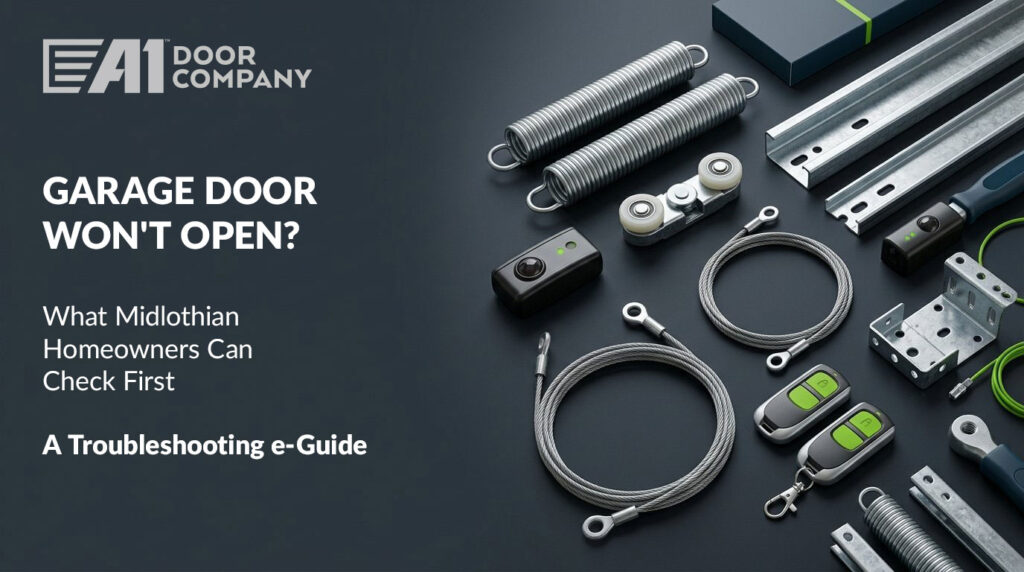
You press the button on your way out the door, and nothing happens. Or the opener hums, the door shudders a few inches, and then it stops. Your car is inside, you have somewhere to be, and the first question is always the same: is this something I can fix myself, or do I need help?
The good news is that a lot of “my garage door won’t open” moments come down to simple causes. A tripped breaker, dead remote batteries, a dirty safety sensor, or a wall control accidentally switched into lock mode can all stop a perfectly healthy door. Those take minutes to check and cost nothing.
The less welcome news is that some causes are serious. A broken spring or snapped cable can make a door dangerous to touch, and trying to force it open can turn a single repair into several. Knowing the difference is what keeps you safe and keeps the repair bill reasonable.
In this e-guide, Midlothian homeowners learn how the parts of your garage door work together, how to read the symptoms your door is giving you, which checks are safe to try on your own, and the clear signs that it’s time to stop troubleshooting and call a technician.
Here’s everything you need to know about troubleshooting a garage door that won’t open, starting with what’s actually happening when it refuses to move.
Understanding Why a Garage Door Refuses to Move
Most people think of the opener as the thing that lifts the door. It isn’t. The springs do the heavy lifting by counterbalancing the door’s weight, and the opener simply guides that balanced door up and down.
Think of it like a seesaw. When the springs are working, a door that weighs a couple hundred pounds feels light enough to lift by hand. When a spring breaks, that balance disappears, and the opener is suddenly asked to lift the full weight on its own. Many openers will strain, stop, or refuse to try.
A typical residential door relies on a handful of parts working together:
Springs: Torsion springs sit on a bar above the door; extension springs run along the horizontal tracks on each side. Either type stores the energy that lifts the door.
Cables and drums: Cables connect the springs to the bottom of the door and carry the lifting force. If one frays or slips off its drum, the door can lift unevenly or jam.
Tracks and rollers: These keep the door moving in a straight path. A bent track or worn roller creates friction that can stop the door mid-travel.
Opener and controls: The motor, remotes, wall button, and safety sensors decide when the door moves and when it reverses.
The biggest misconception is that a door that won’t open means a dead opener. Often the opener is fine and is protecting itself from a door that has lost its balance. That’s why diagnosis matters before anyone buys a new motor.
Why Diagnosing First Saves Money and Keeps You Safe
Guessing at the problem is expensive. Replacing an opener when the real issue was a broken spring means paying for two jobs, because the new opener still can’t lift an unbalanced door. Starting with a few simple checks rules out the easy fixes and points you toward the real cause.
Safety is the bigger reason. Springs are under enough tension to cause serious injury if they’re handled without the right tools and training. A door with a failed spring or cable can also drop unexpectedly once it’s released from the opener.
Taking a few minutes to observe the symptoms helps you avoid the riskiest mistakes: pulling the emergency release on a door that’s no longer balanced, or repeatedly hitting the button and burning out the motor.
It also makes any service call faster. When you can tell a technician “the motor hums but the door doesn’t move, and I heard a bang last night,” you’ve already narrowed the problem down. If you want a sense of what different fixes tend to involve, our overview of garage door repair cost explains the factors that drive pricing.
How to Tell Which Part Has Failed
Your door usually tells you what’s wrong if you pay attention to what it does, and doesn’t do, when you press the button. Here’s how to read the most common symptoms.
Nothing Happens When You Press the Button
No sound, no lights, no movement usually points to power or controls. Check whether the opener light works, whether the outlet has power, and whether the breaker has tripped. If the wall button works but the remote doesn’t, the remote battery is the likely culprit.
Many wall controls also have a lock or vacation mode that disables remotes. It’s easy to press by accident, and it makes a working door look broken.
The Motor Hums but the Door Stays Put
A humming or clicking opener with a motionless door is a classic sign of a broken spring. Look at the torsion spring above the door for a visible gap in the coil. A loud bang from the garage in the last day or two is another strong clue.
Humming can also come from worn opener gears or a door that’s binding in its tracks. If the opener seems to be the issue rather than the springs, our guide on how to repair a malfunctioning garage door opener covers what’s worth trying.
The Door Starts, Then Reverses
A door that moves a little and then goes back is usually reacting to its safety system. Misaligned or dirty photo-eye sensors near the floor are the most common cause. Blinking sensor lights generally mean they can’t “see” each other.
Reversing can also be the opener sensing too much resistance, which brings us back to spring balance or a binding track.
The Door Is Stuck Partway or Hanging Crooked
An uneven or tilted door often means a cable problem or a roller that has left the track. A broken garage door cable can leave one side higher than the other. Treat a crooked door as unstable and keep people and vehicles away from it.
Five Safe Checks You Can Do in Ten Minutes
Before calling anyone, work through these checks in order. None of them involve touching tensioned parts.
1. Confirm power. Make sure the opener is plugged in, the outlet works, and the breaker or GFCI outlet hasn’t tripped.
2. Test both controls. Try the wall button and the remote. If only one works, replace the remote battery or check the wall control’s lock setting.
3. Clean and align the sensors. Wipe the lenses on both photo-eyes with a soft cloth. Make sure nothing is blocking the beam and that both units point straight at each other with steady lights.
4. Look, don’t touch. From a safe distance, check the springs for gaps, the cables for fraying or slack, and the tracks for dents or rollers that have popped out.
5. Test the balance, only if everything looks intact. With the door fully closed and no visible spring or cable damage, pull the emergency release and lift the door by hand to about halfway. A balanced door stays roughly in place. If it’s very heavy or drops, lower it carefully, leave it closed, and call for service.
If one of these checks solves the problem, great. If not, you’ve ruled out the easy causes and gathered useful details for a technician. For a broader checklist, see these top signs your garage door needs repair.
Where DIY Troubleshooting Goes Wrong
The line between helpful troubleshooting and a risky repair is clear: anything under tension is off limits. That includes springs, cable drums, and the bottom brackets where cables attach to the door. These parts can release a lot of force suddenly.
A few other common mistakes are worth avoiding:
- Pulling the emergency release on a door with a broken spring: Without spring support, the door can fall fast. Only use the release when the door is fully closed and the springs look intact.
- Forcing an off-track door: Running the opener or pushing the door back into place can bend the tracks further and damage panels. Leave it where it is.
- Repeatedly pressing the button: If the motor strains and nothing moves, continuing to try can overheat or damage the opener.
- Adjusting opener force settings to “push through”: Turning up the force can mask a balance problem and make the auto-reverse less sensitive, which is a safety risk.
If your checks point to springs, cables, tracks, or a door that’s heavy or crooked, that’s the moment to bring in our Midlothian garage door repair team. Neighbors in Powhatan run into the same failures, and the safe answer is the same everywhere: let a trained technician handle tensioned parts.
Habits That Keep Your Door Opening Every Morning
Central Virginia weather is tough on garage doors. Humid summers can swell wood doors and trim, and winter cold stiffens lubricant and makes metal parts work harder. A spring that breaks on a cold morning was usually already worn, and the cold just finished it off.
A few simple habits catch problems before they leave you stuck:
- Watch and listen monthly: Run the door and pay attention to grinding, popping, jerky movement, or one side lagging behind. New noises are early warnings.
- Test the auto-reverse: Place a sturdy object like a piece of lumber flat in the door’s path. The door should reverse when it touches it. If it doesn’t, have it checked.
- Keep sensors clear: Bikes, bins, and lawn equipment often end up in front of the photo-eyes. Keep that area open.
- Lubricate moving parts: Use a garage-door-rated lubricant on rollers, hinges, and springs a couple of times a year. Avoid heavy grease, which collects dirt.
- Schedule annual service: A yearly inspection covers balance, hardware, cables, and safety features. It’s the easiest way to catch a worn spring before it breaks.
Doors that keep needing repairs may be telling you something bigger. If you’re weighing your options, our guide on whether to repair or replace an old garage door can help you decide. Homeowners across Richmond face the same seasonal wear, so a little prevention goes a long way.
Bringing It Together for Midlothian Homeowners
When your garage door won’t open, start simple. Check power, test both controls, clean the sensors, and look over the springs, cables, and tracks from a safe distance. Those steps solve a surprising number of problems and tell you a lot about the ones they don’t solve.
Just as important is knowing where to stop. A humming motor with a still door, a loud bang, a gap in a spring, frayed cables, or a door that hangs crooked all point to parts that are under tension or holding weight. Those aren’t weekend projects, and forcing them usually makes the repair bigger.
A1 Door Company has been family-owned since 2002, and our technicians repair springs, cables, tracks, and openers on all major brands, including Amarr, Clopay, CHI, Raynor, Wayne Dalton, and LiftMaster. We’ll explain what failed, give you a price before any work starts, and tell you honestly whether a repair or a replacement makes more sense.
If your checks didn’t get the door moving, our team can take it from here. Learn more about our garage door repair services in Midlothian or Schedule Now.





 Tap to Call
  Tap to Book!