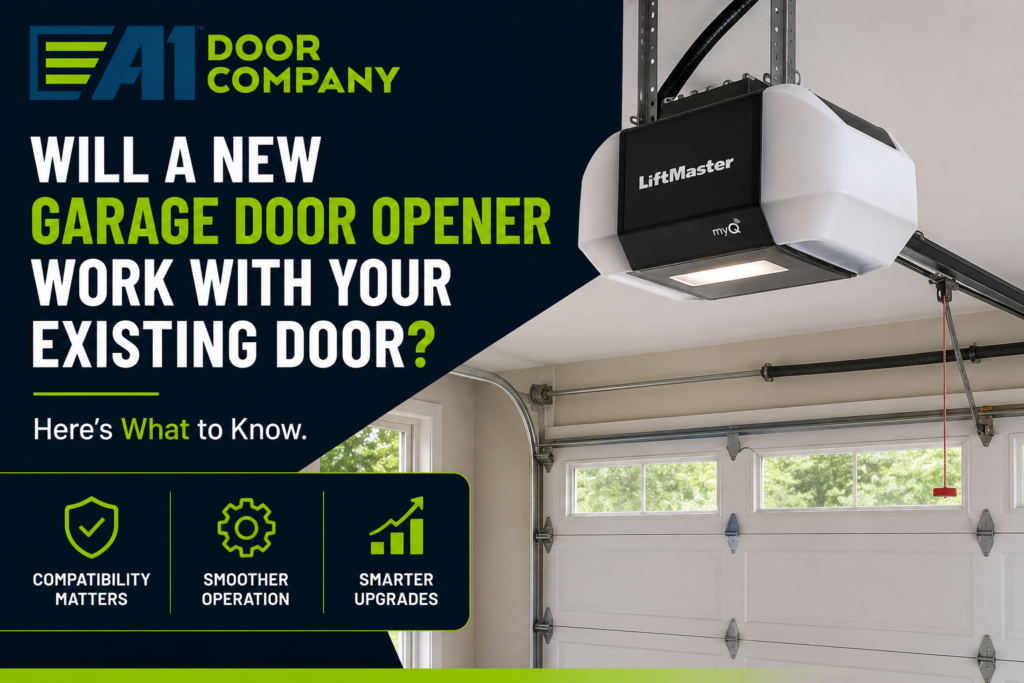
You’ve got a garage door that’s working fine, but the opener is finally giving up the ghost. Maybe it’s slow, noisy, or just plain old. You start shopping for a replacement and then the question hits: will a new opener actually work with my existing door? Especially if the brands don’t match?
It’s a fair thing to wonder. Walk into any home improvement store or browse online and you’ll find openers from several manufacturers, while your door might be an Amarr, a Clopay, or something else entirely. The good news is that compatibility between openers and doors is much simpler than it looks. Most modern openers are built around standard residential door systems, not brand-specific ones. Here’s what actually matters.
Why Opener Brands and Door Brands Don’t Need to Match
The reason most openers work with most doors comes down to how they physically connect. A garage door opener attaches to your door through a trolley and rail system. The trolley clamps onto the top section of the door and pulls or pushes it along the track. That mechanism is universal across the residential garage door industry.
Major door manufacturers including Amarr, Clopay, CHI, Raynor, and Wayne Dalton all follow standard sizing and mounting conventions. They’re not building doors with proprietary attachment points that only accept certain opener brands. The industry settled on these standards a long time ago, which is why a LiftMaster opener can go on an Amarr door just as easily as any other combination.
What actually determines whether an opener is the right fit has nothing to do with the name on your door panels. It comes down to the door’s weight, its height, and the type of spring system you have. Those are the real variables. If you’re still learning the basics, understanding how garage doors work can help you ask the right questions before you buy.
What Actually Determines Whether an Opener Will Work
Think of it this way: your opener’s job is to lift a heavy moving object repeatedly, day after day. The factors that matter are all mechanical.
Horsepower rating: This is the most practical compatibility factor. A standard single-car door typically works fine with a 1/2 HP motor. A heavier two-car door, especially a thick carriage-style door, usually calls for 3/4 HP or even 1 HP. Undersizing the motor is a common mistake that leads to premature wear and sluggish performance.
Drive type: Chain drives are durable and affordable but noisier. Belt drives run quieter, which matters if you have a bedroom above the garage. Screw drives require less maintenance but can be sensitive to temperature swings. None of these choices are brand-dependent — they’re about your preferences and how your home is built. You can explore smart garage door opener options that cover all major drive types and feature sets.
Ceiling height and headroom clearance: The opener rail needs enough clearance above the door to function properly. Standard doors (7 or 8 feet tall) fit most opener configurations without issue. If your door is taller or your ceiling is lower than typical, you may need a specific rail extension or a low-clearance mounting kit. That’s a space issue, not a brand mismatch.
Spring system type: Torsion springs (mounted horizontally above the door) and extension springs (mounted along the sides) both work with standard openers. The spring system just needs to be in good working order before a new opener goes in.
When Things Get More Complicated
Most installations are straightforward, but a few situations deserve a closer look before you commit to a new opener.
The most common one is an older door with worn or unbalanced springs. If the springs aren’t doing their job, the opener has to compensate by working harder than it should. You might notice the opener straining on the way up, or reversing unexpectedly. People often assume the opener is incompatible with the door, but the real issue is that the door isn’t balanced correctly. Understanding how garage door springs work can help you identify whether that’s the problem before you invest in a new opener.
Non-standard door heights are another situation worth flagging. If your door is taller than 8 feet, you’ll likely need a rail extension kit to accommodate the extra travel distance. This is a mechanical adjustment, not a sign that your door and opener are mismatched by brand.
One thing worth clearing up: smart opener features like app control, Wi-Fi alerts, and camera integration have nothing to do with your door brand. Those features connect to your smartphone and your home network, not to the door itself. Whether your door is five years old or twenty, a smart opener will deliver the same functionality as long as the door is in good mechanical condition.
Smart Openers Work Across the Board
If you’re thinking about upgrading to a smart opener, the cross-brand compatibility question becomes even simpler. Modern smart openers, including LiftMaster models with built-in Wi-Fi, are designed for standard residential doors regardless of manufacturer.
The smart features live in the opener’s motor unit and its connection to your home network. App control, real-time alerts, and remote monitoring are all software-based. The door just needs to open and close reliably. A well-maintained Clopay door from fifteen years ago will work just as well with a new smart opener as a brand-new Wayne Dalton door would.
The upgrade path is genuinely open to most homeowners, which is worth knowing if you’ve been putting it off because you weren’t sure your door was “compatible.” Homeowners in Fredericksburg, Richmond, and Virginia Beach have all made this upgrade without needing to replace their existing doors.
Signs Your Door Might Be the Real Problem
Sometimes what looks like an opener issue is actually a door issue. A few things to watch for:
Opener strains or reverses unexpectedly: This usually points to spring balance problems, not a brand incompatibility. The opener is sensing resistance and responding the way it’s designed to.
Grinding or scraping sounds: Often a sign of worn rollers, bent tracks, or hardware that needs attention, not a sign that the opener is wrong for the door.
Safety sensor issues: The photo-eye sensors near the floor can malfunction from misalignment or dirt buildup. This is a maintenance issue that affects every opener brand equally.
If your door is off-track, has damaged panels, or has a broken spring, those problems need to be resolved before any opener installation. Putting a new opener on a door that isn’t functioning properly will just put extra strain on the new equipment. Homeowners dealing with these issues in Chesapeake and Colonial Heights can reach out to our team for a full door assessment before installation.
How We Approach Opener Installation at A1 Door Company
When we install or replace an opener, we don’t just bolt it in and hand you the remote. We look at the whole door system first. That means checking the spring balance, measuring headroom clearance, and assessing the door’s weight to make sure we’re recommending the right LiftMaster model for your specific setup.
We install LiftMaster openers on all major door brands, and we handle the full setup: programming remotes, testing the safety reversal system, and confirming the opener is properly matched to the door’s weight and travel distance. If you’ve ever dealt with a malfunctioning garage door opener, you know how disruptive it can be — which is exactly why we take the time to get the installation right from the start.
If we spot a worn spring or a sensor issue during the installation, we’ll tell you before it turns into a bigger repair down the road. That’s just how we’ve operated since 2002, and it’s the kind of honest service that keeps homeowners from getting surprised by problems they didn’t know were there.
The Bottom Line
Compatibility between a new opener and your existing door is rarely the complicated puzzle it seems like. The door brand almost never matters. What matters is the door’s weight, height, spring condition, and the available headroom in your garage. Get those factors right, and the opener will do its job reliably for years.
If you’re not sure what opener fits your door, or if your current setup has been giving you trouble, we’re happy to take a look. Give A1 Door Company a call and we’ll figure out exactly what you need. Schedule Now and let’s get your garage door working the way it should.

 Tap to Call
  Tap to Book!